Leonard Mashilompane: The Bold Vision of a Young Leader Who Says South Africa Needs a Reset
Reading Time: 10 minutesMashilompane shares his bold vision for South Africa, Madibeng, clean government, employment, accountability and a corruption-free future.

Leonard Tebogo Mashilompane, National Leader and President of Forum4SA, is contesting the Madibeng mayoral seat. Photos: Supplied
There was something refreshing about speaking to Leonard Tebogo Mashilompane. Not because he is a politician with all the answers.
In fact, perhaps the opposite.
Mashilompane took his time answering a long list of questions about his life, leadership, corruption, service delivery, employment, Madibeng and the future of South Africa.
He was busy. Yet, rather than firing off hurried responses, he would return with a courteous message to say that he was still working through the questions. That happened until he eventually completed the entire questionnaire.
In an age when artificial intelligence can produce polished answers in seconds, that patience was striking. Mashilompane appeared determined to think before he answered.
And perhaps that says something about the man behind the political candidate. The young activist, civic leader and National Leader and President of the Forum for South Africa (Forum4SA/FOSA) is contesting the Madibeng Local Municipality mayoral seat.
His political message is uncompromising: corruption must be confronted, government must become accountable and ordinary South Africans must see tangible improvements in their daily lives.
But behind the political manifesto is a personal history that started long before Mashilompane became a candidate.
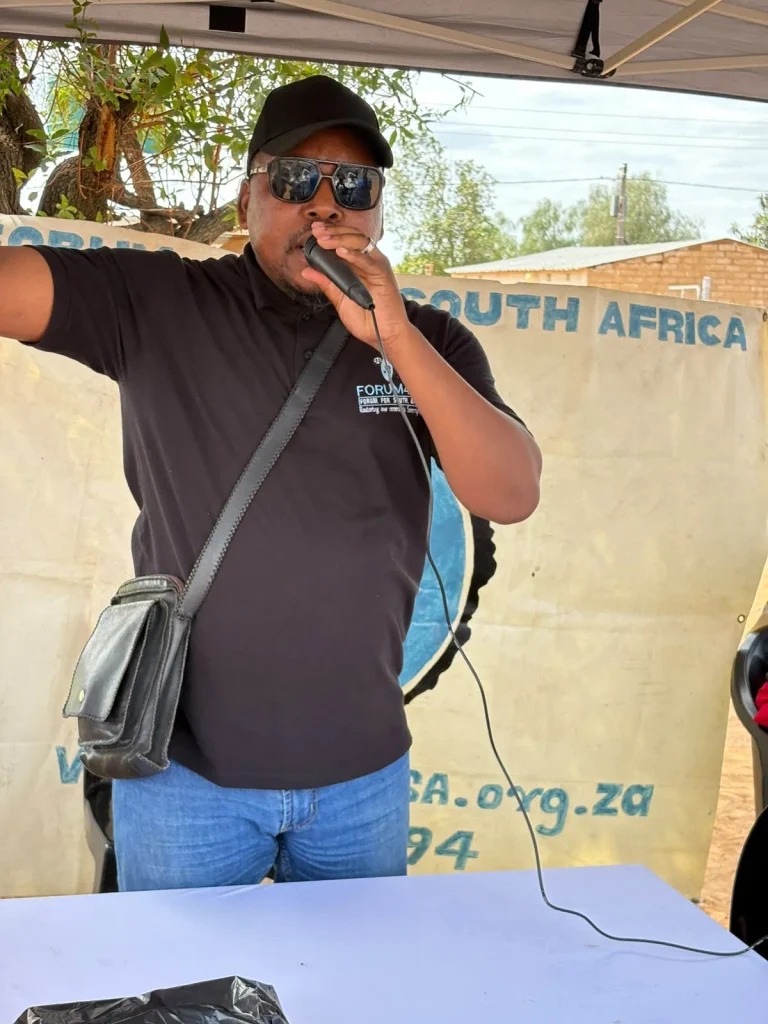
Mashilompane grew up surrounded by politics
“I grew up in politics,” Mashilompane says.
He was born in Attridgeville, west of Pretoria, where he spent part of his childhood witnessing riots and experiencing the reality of political unrest from his own yard. He later moved to the North West during the days of Bophuthatswana. Politics, therefore, was never an abstract subject to him.
He grew up in an environment where political consciousness was simply part of life. As a teenager, his late uncle, known as Uncle Joe, introduced him more deeply to PAC politics.
His interest grew.
At high school, Mashilompane became vice-chairperson of the Pan Africanist Student Organisation (PASA), the PAC’s student wing at school. When he went to Technikon Northern Gauteng, now Tshwane University of Technology (TUT), he continued his political involvement through PASMA, the tertiary student wing of the PAC.
But his political journey was not a straight line.
After Patricia de Lille left the PAC, Mashilompane felt the organisation was deteriorating and no longer had the focus he believed it needed. He subsequently joined de Lille’s Independent Democrats. In 2006, while still in his early 20s, he stood as an Independent Democrats councillor candidate in Tshwane.
He lost . . . badly, by his own admission.
The defeat hurt.
Mashilompane had campaigned tirelessly in Sunnyside, particularly among young people, and believed his message was resonating.
Then he discovered he had been registered in the wrong ward.
“It broke me,” he recalls.
Yet politics did not leave him.
He simply stepped away from direct political participation for a period.
Mashilompane chose self-development before returning to politics
During his political break, Mashilompane focused on education, business and professional employment. He also worked as a campaigns and communications director for various political parties.
That experience became an education of another kind.
Working behind the scenes allowed him to observe different political ideologies, as well as the successes and failures of different political organisations.
Eventually, he reached a conclusion. South Africa, he believed, was in trouble.
He could not find a political party that he felt could become a vehicle for the kind of success he wanted for ordinary South Africans. He became increasingly frustrated by poor service delivery despite resources being available, and by corruption within municipalities, particularly around tenders and procurement.
Eventually, Mashilompane faced a choice.
He could concentrate on his own life and family while watching the country deteriorate, or put those priorities temporarily aside and confront the problems he believed were damaging South Africa.
“The latter won,” he says.
That decision led to the creation of Forum for South Africa, popularly known as Forum4SA or FOSA.

About Corruption: “A war must be declared against it . . .”
— Tebogo Mashilompane
Why Mashilompane created Forum4SA
For Mashilompane, Forum4SA was initially a platform through which he could expose and challenge what he describes as a broken system. But he also wanted it to become a home for like-minded people who wanted to fight for the rights of ordinary citizens, particularly poor, marginalized, unemployed and working-class South Africans.
His definition of leadership is equally direct.
Leadership, he says, must first be informed by servanthood. It is also influence.
And, importantly, he believes leadership is not for cowards.
For Mashilompane, genuine leadership requires selfless people willing to sacrifice for the success and liberation of others. That philosophy also shapes how he describes himself.
“I am a clear individual. What I say is what I mean.”
He says his upbringing taught him patience, Ubuntu, ethics and honesty.
He does not claim perfection. Instead, he says he believes in fair judgement and is prepared to give credit to a critic when that critic is right.
He also believes his own views must be capable of being challenged. When challenged, he says, he must be humble enough to introspect. It is an unusually important statement in an era when political disagreement can quickly become personal.
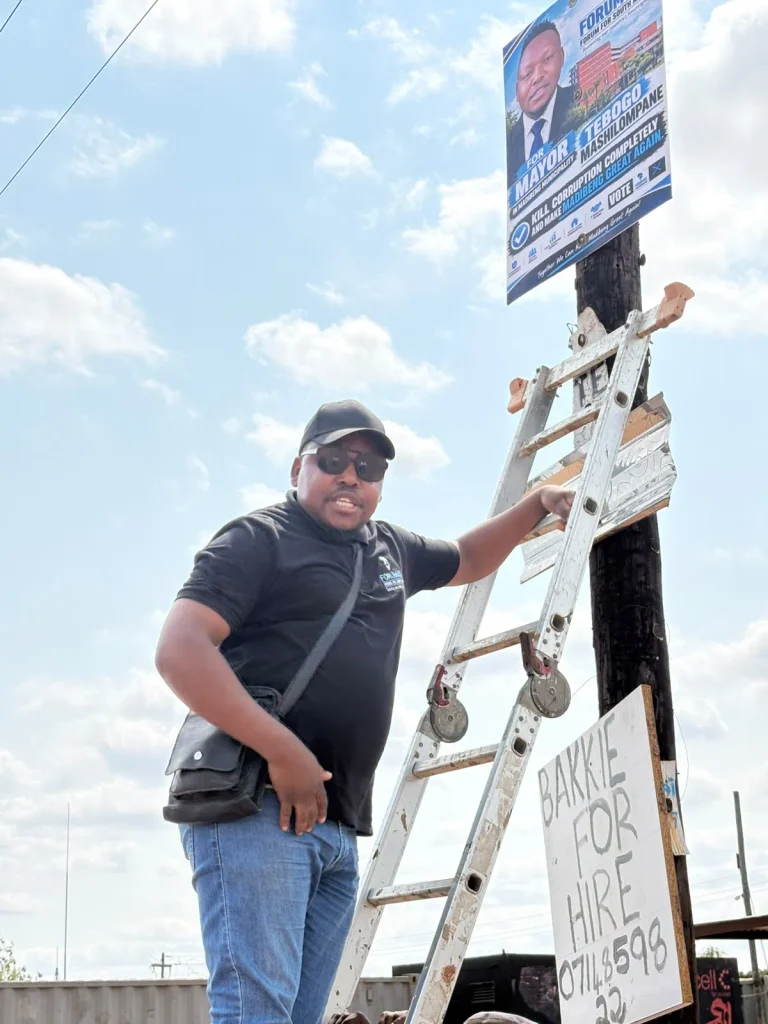
Mashilompane puts corruption at the centre of his campaign
If there is one issue that dominates Mashilompane’s political thinking, it is corruption. His answer is unequivocal: a war must be declared against it. He argues that corruption creates a chain reaction, contributing to criminality, illegality, unemployment and abuse, including gender-based violence and femicide (GBVF).
To explain his reasoning, he uses the example of a R200 million road tender.
If such a contract is awarded to a friend or an inexperienced person because of favouritism, he argues, profit can become more important than quality. Those involved in awarding the contract may also seek to benefit from the same money. Temporary workers may struggle to receive their full wages.
Poor workmanship can mean the road needs to be repaired or rebuilt, creating another opportunity for more public money to be spent. And, he argues, criminal elements can emerge around lucrative tenders, creating threats and even violence.
For Mashilompane, the lesson is simple: one corrupt tender can create an ecosystem of other problems. His answer is therefore not simply to manage corruption better.
He wants to remove what he sees as the structures that allow it to flourish.
Mashilompane wants a different approach to government
If Forum4SA were to lead the country, Mashilompane says the organization would impose strict requirements on people seeking Cabinet positions. Only people he describes as blameless would be appointed as Ministers.
He wants constitutional changes to strengthen citizen protection and serious measures against criminals. He also believes South Africa’s correctional system needs reconsideration, arguing that prison is no longer a sufficient deterrent when prisoners can choose whether or not to participate in rehabilitation and skills programmes.
His proposed agenda also includes retraining the police and separating policing into a police service and a police force.
On immigration, Forum4SA’s position is hard-line: Mashilompane says the party would close the borders and would not entertain illegal immigration.
Once national security is addressed, he says the focus would shift towards economic growth through South Africa’s mineral resources, agriculture, tourism and business development.
Education would also be changed immediately because, in his view, the current system does not adequately respond to the challenges of the day.
He would also abolish the tender system, except for a limited need for specialized skills that government does not yet possess.
Mashilompane’s three priorities
Asked to identify the most important issues, his answer is brief: Tender system. Crime. Employment.
His concept of accountability is equally straightforward.
A transparent government, he says, must be in touch with what is happening on the ground.
It must understand that public resources are not intended for friends and family, but for all South Africans. Forum4SA’s policies, he says, include time frames for activities so that progress can be measured. He also proposes a national audit system based on accurate numbers rather than samples. Under his proposal, municipalities would conduct their own audits, followed by provincial and national audits.

Mashilompane wants employment to replace the dominance of tenders
One of his most striking economic proposals is to reduce government tender allocations to 30% while increasing employment opportunities to 70%. In some circumstances, he says, there should be no tender at all.
He wants education transformed to deliberately create entrepreneurs.
Government, he says, should even have a target for the number of millionaires it aims to create within a particular period, with clear mandates defining who should receive support.
He also believes South Africa’s minerals and land must benefit local communities.
His position on small and informal businesses is similarly focused on South African citizens.
He says small businesses and informal businesses should be strictly for South Africans, while financial channels operating in the country should be properly regulated to prevent money from leaving the country. He proposes harsher punishment and blacklisting for people found guilty of wrongdoing.
At the same time, he says informal businesses run by citizens should be allowed to operate without unnecessary interruption. Foreigners, according to his position, should only be allowed to take over businesses in areas where South Africans have no interest, and only after complying with the law and registering properly.
Mashilompane says the problem is implementation
For Mashilompane, South Africa does not necessarily lack laws. It lacks implementation and consequence management. Law enforcement must therefore do its job, he argues, and failure to do so must carry serious consequences. He also believes that putting the right people into the right positions can make a significant difference.
This principle extends to infrastructure.
Mashilompane says one reason communities struggle to access financial services is the lack of security around infrastructure. Forum4SA therefore intends, under his plan, to prioritize safety and security while building relationships with financial institutions and tribal authorities to protect banking infrastructure.
What would Mashilompane do differently in Madibeng?
The mayoral contest in Madibeng gives Mashilompane an opportunity to take his philosophy from national politics into local government. His answer begins with something many municipalities struggle with: money.
He says Madibeng is not collecting enough revenue because residents are not receiving the basic services they are paying for. That creates a vicious cycle.
The municipality cannot provide adequate services, residents become reluctant to pay, revenue falls and service delivery suffers further.
Mashilompane says community engagement would therefore be a major priority during Forum4SA’s first 100 days. The focus would be revenue collection, accompanied by a commitment to providing above-standard services.
He does not want to begin with a blame game.
Instead, he says Forum4SA would diagnose the municipality’s problems and communicate the findings effectively. But he says the party has already researched Madibeng and understands many of its challenges, including poor infrastructure.
His solution includes directly employing highly qualified engineers rather than relying primarily on tenders. He also wants to establish stronger relationships with the private sector and the mines operating around Madibeng.
And above all, he repeats the importance of revenue collection.
Mashilompane: “We are not going to fail”
Perhaps one of his strongest statements comes when he is asked what happens if Forum4SA wins and then fails to deliver.
“We are not going to fail; we are not here to fail.”
Mashilompane says Forum4SA has a plan for municipalities. He does not intend to reveal every element of that plan publicly, but says the first steps would include removing corruption, corrupt individuals and tenders.
And his political philosophy does not begin and end with election day. If Forum4SA wins a majority, it intends to govern according to its own policies. If it falls short but holds enough numbers to influence council, Mashilompane says the party would consider working with newer political parties that share similar values.
But he is clear that Forum4SA would not work with the ANC, EFF, PA or DA.
If voters give the party too few seats to lead or influence council, he says Forum4SA will accept that mandate and remain in opposition.
Mashilompane says Forum4SA exists beyond elections
This may be one of the most revealing parts of his answers. “Forum4SA does not exist because of elections.” Whether the party wins or loses, he says, it will continue serving communities and doing its civic work. That means the movement’s identity, in his telling, is not dependent on holding office.
It is dependent on service.
He also rejects the idea that Forum4SA should support policies simply because older political parties have used them. In his view, established parties have already had opportunities to test their policies, and history has demonstrated their shortcomings. Forum4SA, he says, is bringing fresh ideas designed around what he describes as inclusive, progressive responses to everyday challenges.

Integrity begins inside Forum4SA
Mashilompane’s emphasis on accountability does not stop at government. He says all councillor candidates and leaders in Forum4SA have signed integrity forms and other documents binding their consciences. If someone is found wanting, the rules are clear: they can be dismissed immediately.
He gives the example of the organization’s former National Organiser, who was removed because of ties to the ANC. Mashilompane says the individual had not committed corruption, but had failed the organization’s integrity requirements.
Internally, Forum4SA has a Council of Elders whose role includes maintaining order and discipline. Externally, Mashilompane says any organization, individual or group has the right to hold Forum4SA accountable.
“We are not immune from criticism.”
That sentence perhaps connects most closely to the way Mashilompane describes his own leadership. He says he wants to be challenged.
Mashilompane believes communities already have many of the answers
For Forum4SA, transparent governance and community engagement are central. Mashilompane believes many of the answers to South Africa’s problems can already be found within communities.
People are raising issues every day. The responsibility of the movement, he says, is to amplify those concerns through the media and social media. That approach feeds directly into his vision for Madibeng.
His list of priorities includes improved service delivery, corruption-free municipalities, reduced crime, a 30% tender and 70% employment model, restoring township economies to local people, improving the economy through agriculture, mining and tourism, establishing a new township, providing municipal buses for reliable transport and restoring hijacked buildings.
It is an ambitious list.
The final responsibility belongs to the voters
For all the confidence in Mashilompane’s answers, there is one final element that brings the conversation back to democracy. He believes voters should have the final say.
“If we do not deliver, the voters must remove us from power.”
It is a simple sentence, but it may be one of the most important in the entire interview with Youth Express. Because underneath the politics, the tenders, the economic proposals, the criticism of government and the plans for Madibeng is a belief that leadership ultimately belongs to the people.
And perhaps that is what made this particular exchange memorable.
Mashilompane did not rush his answers.
He took time.
He thought.
He returned when he was still working.
He finished the questions when he could.
That sincerity does not automatically make every political proposal correct, nor does it remove the need for voters to scrutinise policies, evidence and promises.
But sincerity matters. Especially in politics.
Especially when a young African man is willing to say that leadership should be about servanthood, that criticism should be welcomed, that leaders should be held accountable and that public office should ultimately remain in the hands of the people.
For South African men . . . and men everywhere . . . there is something worth noticing in that approach.
Not perfection.
Not performance.
But the willingness to slow down, think carefully, answer honestly and stand behind what you believe.
That, in itself, is leadership worth examining.
Political Content Disclaimer: Youth Express does not endorse or support any political party, candidate or political organization. Our publication of a political story does not constitute an endorsement. We believe in giving communities access to information and diverse political perspectives. Political parties and candidates who wish to share their stories, views or information with Youth Express are welcome to contact us for consideration.
Like this story, tell us what you think in the comments.
Read more of our stories.